Cleopatra's Personal Hairdresser Wrote Down Every Ingredient She Used To Stop The Queen's Hair Loss . Big Beauty Has Spent The Last 30 Years Pretending It Doesn't Exist.
Her name was Iras. For 11 years she kept Cleopatra's hair thick through the Egyptian heat — and Roman historians documented every formulation she used. Top cosmetologist and board-certified dermatologist just reconstructed her recipe. Three cease-and-desist letters later, they're going public.
I'm about to make every dermatologist, hair transplant surgeon, and beauty distributor in America very, very angry.
My name is Lisa Renner.
I've been a licensed cosmetologist for 22 years.
I've held more women's hair in my hands than I can count. I know what healthy hair feels like. I know what damaged hair feels like. And over the past five years, I've felt something behind my chair that still makes my stomach turn.
Hair that's disappearing.
Not breaking. Not split ends. Not over-processed. Disappearing. Getting finer. Getting thinner. Getting less.
And the women sitting in my chair? They knew it too. They just didn't say it out loud.
I'm about to tell you something that the $12 billion hair loss industry does not want you to hear. Something that's going to make every dermatologist, hair transplant surgeon, and supplement company in America furious.
Because a board-certified dermatologist and I stumbled onto the same discovery from completely different worlds — me from behind the salon chair watching it happen in real time, her from inside the medical system watching her patients fail on standard treatments year after year.
What we found could cost them billions in revenue.
And what we traced it back to is the most unlikely source you can imagine.
A 2,000-year-old Roman historical record about a woman named Iras — Cleopatra's personal hairdresser — and the four ingredients she used to keep the most powerful queen in the ancient world from losing her hair.
I've been told to stay in my lane. Told that I'm "just a hairdresser" and I should leave the science to the professionals.
But I don't care anymore.
Not after watching my most loyal clients stop showing up because they were too embarrassed to sit in my chair.
Not after recommending products for 22 years that I now know were nothing more than expensive water with a nice smell.
Not after discovering that the entire hair loss industry has been built on one massive, profitable lie.
If you're reading this with your hair pulled back in that same ponytail that keeps getting smaller…
If you've started avoiding mirrors in bright lighting…
If you're counting the hairs in your shower drain every morning…
If you dread your salon appointment because you know your stylist can see what you're trying to hide…
The next 10 minutes of your life could change everything.
And together with Dr. Yolanda Holmes — a board-certified dermatologist with over 15 years specializing in women's hair and scalp conditions, affiliated with Howard University Hospital and MedStar Washington Hospital Center — I'm about to expose the dirty secret that keeps 40 million American women trapped in thinning hair while the beauty industry laughs all the way to the bank.
But first, let me tell you about the Tuesday afternoon that broke me.
The Kindergarten Teacher Who Sobbed In My Salon Chair Changed Everything
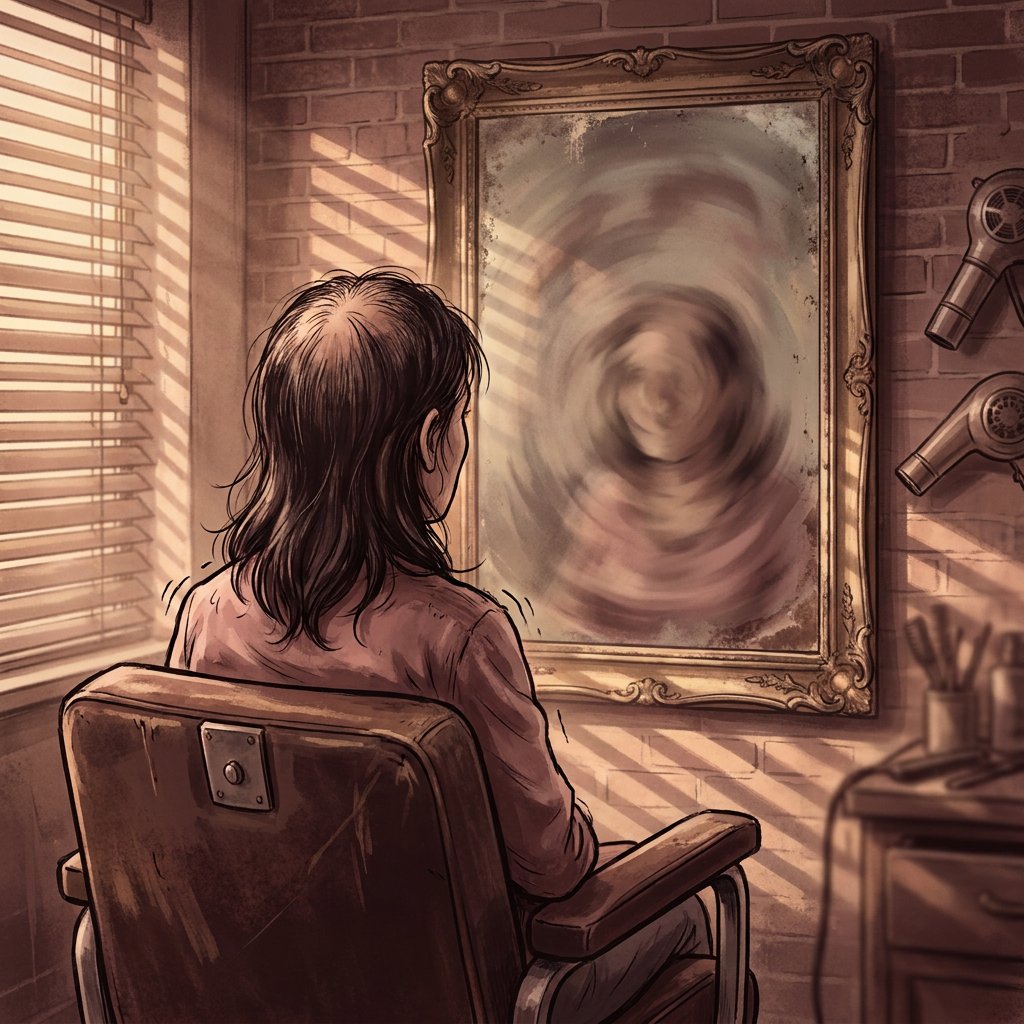
It was 3:00 PM on a Tuesday.
Jennifer sat down in my salon chair for what was supposed to be a routine color and trim. She was 52. Kindergarten teacher. Married 28 years. Two grown kids. The kind of woman who lights up a room.
Except she wasn't lighting up anything that day.
I draped the cape around her shoulders and ran my fingers through her hair like I'd done a hundred times before. And my stomach dropped.
I'd been doing Jennifer's hair for six years. I'd watched it change — slowly at first, then faster. Each visit, I'd adjust. A slightly different part to cover the thinning crown. More layers to create the illusion of volume. A root lift spray to give her some body at the scalp.
I wasn't styling her hair anymore. I was hiding her hair loss. And we both knew it.
But today was different. Today, when I sectioned off her hair to start the color, I could see straight through to her scalp under the salon lights. There was barely enough to work with.
Jennifer looked up at the mirror. Saw me holding a thin, wispy section between my fingers.
And just… broke.
Not crying. Sobbing.
The kind of raw, primal sound that makes your stomach drop and your heart crack wide open.
She couldn't finish.
Her husband hadn't run his fingers through her hair in 18 months. Not because he didn't love her. Because there was barely anything left to touch.
"I'm done, Lisa. I'm buying a wig. I've tried everything. Minoxidil burned my scalp. The supplements did nothing. The extensions damaged what I had left. I'm just… done."
That's when something inside me snapped.
Because I realized — I'd been part of the problem.
For six years, I'd been managing Jennifer's hair loss. Parting it differently. Adding volume with layering tricks. Recommending salon products that promised "thickness" and "fullness" but never delivered anything real.
I wasn't helping her. I was helping her hide.
Recommending the same products every stylist recommends because that's what the distributors put on our shelves. Products that make hair feel thicker for an afternoon but don't do a single thing about why it's falling out. Products that make salon distributors rich while women like Jennifer suffer.
I looked at Jennifer — this vibrant, beautiful woman who'd been reduced to hiding in wigs — and I made a promise.
"Jennifer, give me six months. Don't buy those wigs yet. I'm going to figure out what's actually happening to your hair. And I'm not going to stop until I find the answer."
That night, I went to war with everything I thought I knew about hair loss.
That Night I Did Something No Cosmetologist Is Supposed To Do. I Stopped Trusting My Own Industry.

The first thing I did was something no cosmetologist is supposed to do.
I stopped trusting my own industry.
I went into my salon at 11 PM that night with a notebook and a flashlight, and I pulled every single product off my shelf. Every volumizing shampoo. Every "thickening" treatment. Every "follicle-strengthening" serum I'd been selling for years.
I sat on the floor. And I read every ingredient label.
Really read them.
What I found made me physically sick.
Most of them were 95% water and fillers with a trace amount of "active" ingredients. Just enough to slap on the label. Not enough to actually do anything.
I'd been selling hope in a bottle. For 20 years.
Then I started Googling. Late into the night. Reddit threads. Hair loss forums. Facebook groups for women over 40 dealing with thinning.
And I read the same heartbreaking lines my clients had said to me — typed by thousands of strangers.
"I've tried everything and nothing works."
"I spent over $3,000 on hair products and saw no results."
"My doctor told me to just accept it. It's aging."
That last one. That's the one that did it.
Because I'd heard it in my chair too many times to count. My doctor said it's just aging. My doctor said it's just menopause. My doctor said it's genetic.
And every single one of those women left their doctor's office and went home and kept losing their hair.
Then I hit a word that stopped me cold.
DHT.
Dihydrotestosterone.
A hormone studied extensively in male hair loss — but barely mentioned in the conversation about women.
I didn't fully understand it yet. I'm a hairdresser, not a scientist. But I recognized the pattern. After 40 — especially during perimenopause and menopause — something hormonal was attacking my clients' follicles. And nothing on my shelf was even trying to address it.
I'd been decorating hair loss for 22 years.
It was time to start fighting it.
Three Weeks In, I Was Reading 2,000-Year-Old Roman Historical Records. I Couldn't Believe What I Was Finding.

For three weeks, I lived like a woman possessed.
I was reading clinical journals at 2 AM. I was emailing trichologists in Europe. I was buying out-of-print books on the history of hair loss. I spent $1,400 of my own money on academic papers I could barely understand half of.
And then, three weeks in, I was reading a 2014 botanical research paper on traditional medicine — and I hit a footnote.
A footnote.
It cited an obscure Roman historical text. Plutarch's Life of Antony. Written around 75 AD.
The footnote claimed Plutarch had documented the formulations used by Iras — Cleopatra's personal cosmetician and hairdresser — and that several of the botanical ingredients she'd used had been independently confirmed in modern peer-reviewed research as inhibitors of 5-alpha reductase, the enzyme responsible for producing DHT.
I read that footnote four times.
Then I went down the rabbit hole.
Iras was real. She wasn't a marketing invention. She was Cleopatra's most trusted attendant for the last 11 years of the queen's life. Hairdresser. Pharmacist. Cosmetician. Confidante. When Cleopatra died, Iras chose to die beside her — that detail is documented by Roman historians.
But here's what stopped me cold:
Cleopatra was 39 years old when she died.
In an era when women routinely lost their hair in their 30s due to malnutrition, harsh climate, lice, and constant childbirth — Cleopatra's hair was famously, almost mythically, full and thick. Plutarch wrote about it. Roman historians wrote about it. Even centuries later, scholars wrote about it.
How?
Iras knew how.
And she'd written it down.
The royal court guarded the formulations for 300 years after Cleopatra's death. Then Rome fell, the Library of Alexandria burned, and most of the original documentation was lost forever.
But not all of it.
Pieces survived. In Plutarch. In the Egyptian medical papyri. In the writings of Greek physicians who'd trained in Alexandria during Cleopatra's reign.
I started piecing them together. Like a detective working a 2,000-year-old cold case.
What I found in those fragments — what Iras had written down, what Roman historians had preserved, what modern dermatology had completely forgotten — would explain everything.
It would explain why Jennifer's hair was falling out at 52. It would explain why every product on my shelf had failed her. It would explain why 40 million American women were quietly losing their hair while spending billions of dollars on solutions that were never designed to work.
But I needed help. I needed someone with real medical credentials to look at what I'd found and tell me if I was crazy.
That's when I sent the email that changed everything.
Four Ingredients. Four Plants. Four Things Big Beauty Cannot Patent — Which Is Exactly Why You've Never Heard Of Them.

Before I tell you about that email, let me tell you what I'd pieced together by then.
Four ingredients. Four plants. Four things that show up repeatedly across the surviving fragments of Iras' formulations and the Egyptian medical papyri.
Four things Big Beauty cannot patent — which is exactly why you've never heard of them.
The first was a flowering root the Egyptian texts called "the bitter yellow flower." Egyptian physicians used it for what they called "hair vanishing." Modern botanists know it as Sophora flavescens. It's been used in Traditional Chinese Medicine for over 1,000 years for the same purpose. The Egyptians and the Chinese had figured out the same thing, half a world apart, two thousand years before modern dermatology.
The second was a stimulating compound the Egyptians extracted from a roasted bean. They didn't drink it like we do. They applied it directly to the scalp as a tonic. We know it now as caffeine. Modern beauty companies put trace amounts of it in shampoo as a marketing gimmick. Iras used it at clinical concentration. Daily. Topically.
The third was a grain extract that shows up in nearly every royal Egyptian beauty preparation. Crushed, fermented, applied as a paste. Iras used it because her predecessors had used it for centuries. We know it as Oryza sativa. Rice extract. The Yao women of Huangluo, China still use a fermented version of it today — and they're famous worldwide for having floor-length, jet-black hair into their 80s.
The fourth was a root the Egyptians imported from the East along the spice routes. They called it the "hot blood root" because of its ability to stimulate circulation when applied to the skin. Modern science calls it Angelica polymorpha sinensis. It's been used in Chinese medicine for over 2,000 years for female-specific conditions — including hair preservation.
Four ingredients. All botanical. All non-patentable. All forgotten.
Or — more accurately — deliberately forgotten.
Because here's what I couldn't figure out at the time:
If these four ingredients had been used successfully for thousands of years, by the most beauty-obsessed civilizations in history, why had I never heard of any of them in 22 years of cosmetology training?
Why weren't they in any product on my shelf?
Why hadn't a single dermatologist Jennifer had seen — and she'd seen four — ever mentioned even one of these ingredients to her?
The answer would come from the dermatologist who responded to my email in 24 hours flat.
Then I Found A Dermatologist Who'd Been Researching The Exact Same Ingredients From The Other Side.

I'd been searching for someone — anyone — in the medical establishment who was asking the same questions I was asking.
That's when I found Dr. Yolanda Holmes.
She'd published a paper three years earlier in a small dermatology journal questioning why standard hair loss treatments for women had a 60% failure rate — and why the medical establishment kept prescribing them anyway. The paper had been quietly buried.
I read it twice. Then I sent her a cold email.
I didn't expect a response. I'm a hairdresser. She's a board-certified dermatologist with hospital affiliations and 47 published papers.
She responded in 24 hours.
Lisa — you're the first hairdresser who's ever contacted me about this. Everyone in my field is focused on prescriptions and procedures. Nobody in yours is asking why the products don't work. I've been waiting for someone like you for years. We need to talk.
We got on a phone call that lasted four hours.
I told her about Jennifer. About the rabbit hole. About Iras. About the four ingredients I'd traced back through 2,000 years of historical record.
She was quiet for a long time. Then she said something I'll never forget:
"Lisa, I've been researching three of those four ingredients for the last six years. From the clinical side. I have peer-reviewed studies sitting on my desk right now showing exactly why they work. I just never thought to ask where they came from."
What Dr. Holmes showed me over the next three months changed everything I thought I knew about hair.
I'm going to let her explain it in her own words — because what she told me made me furious.
Dr. Holmes Showed Me The $12 Billion Lie That's Keeping You Bald
When Lisa first contacted me, I'll admit — I was surprised. In 15 years of practicing dermatology, I'd never had a hairdresser reach out about clinical research.
But she was asking exactly the right questions. The same ones I'd been asking for years. The ones that nearly cost me my medical license.
Here's what they don't want you to know:
They've been telling you that hair loss after 40 is "genetic" or "just part of aging." That there's nothing you can really do except "manage it" with expensive treatments.
That is a flat-out lie.
Here's the proof: in 1994, researchers at the University of Frankfurt published a groundbreaking study in the Journal of Clinical Endocrinology.
They found that 91% of menopausal women experiencing hair loss had DHT levels comparable to balding men.
Not "slightly elevated." Levels comparable to balding men.
DHT is a hormone that's been studied extensively in male hair loss. But here's the kicker: women produce DHT too. And after 40, we produce more of it.
This hormone literally wraps around your hair follicles and chokes them to death. One by one. Until you're left with baby-fine wisps that barely cover your scalp.
So why haven't they created solutions that actually target it?
Simple. There's more money in keeping you dependent on products that don't work. Think about it:
- Minoxidil? Just temporarily increases blood flow. Doesn't block DHT. Stop using it and your hair falls out again within weeks. Customer for life. Ka-ching.
- Supplements? They might give you stronger nails, but they don't block DHT. Monthly subscription forever. Ka-ching.
- $3,000 PRP injections? They stimulate growth factors temporarily but never address the hormonal root cause. Repeat every 3-6 months. Ka-ching.
- Hair transplants? They move hair from back to front, but DHT keeps killing follicles. Need more transplants in 2-3 years. Ka-ching.
The entire industry is built on keeping you trapped in a cycle of expensive, ineffective treatments.
And here's what made Lisa's discovery so important — what made me sit up and pay attention to a hairdresser when I would have ignored anyone else:
The four ingredients Iras used were targeting DHT directly.
Two thousand years ago. Without knowing the word "hormone." Without a single piece of laboratory equipment. Iras and her predecessors had figured out — through generations of observation and refinement — what modern dermatology has refused to put in a single mainstream product.
That's not folklore. That's not "ancient wisdom." That's empirical observation across 2,000 years of recorded medical history.
And it's been right there the whole time.
Why Everything You've Tried Has Failed

When Dr. Holmes explained DHT to me, I thought about every client I'd ever lost. Every woman who stopped coming to my salon because she was too embarrassed. Every bottle of volumizing shampoo I'd recommended that was nothing more than expensive water.
They weren't failing because they weren't trying hard enough. They were failing because nobody — not their doctor, not their stylist, not the brands they trusted — was addressing the actual cause.
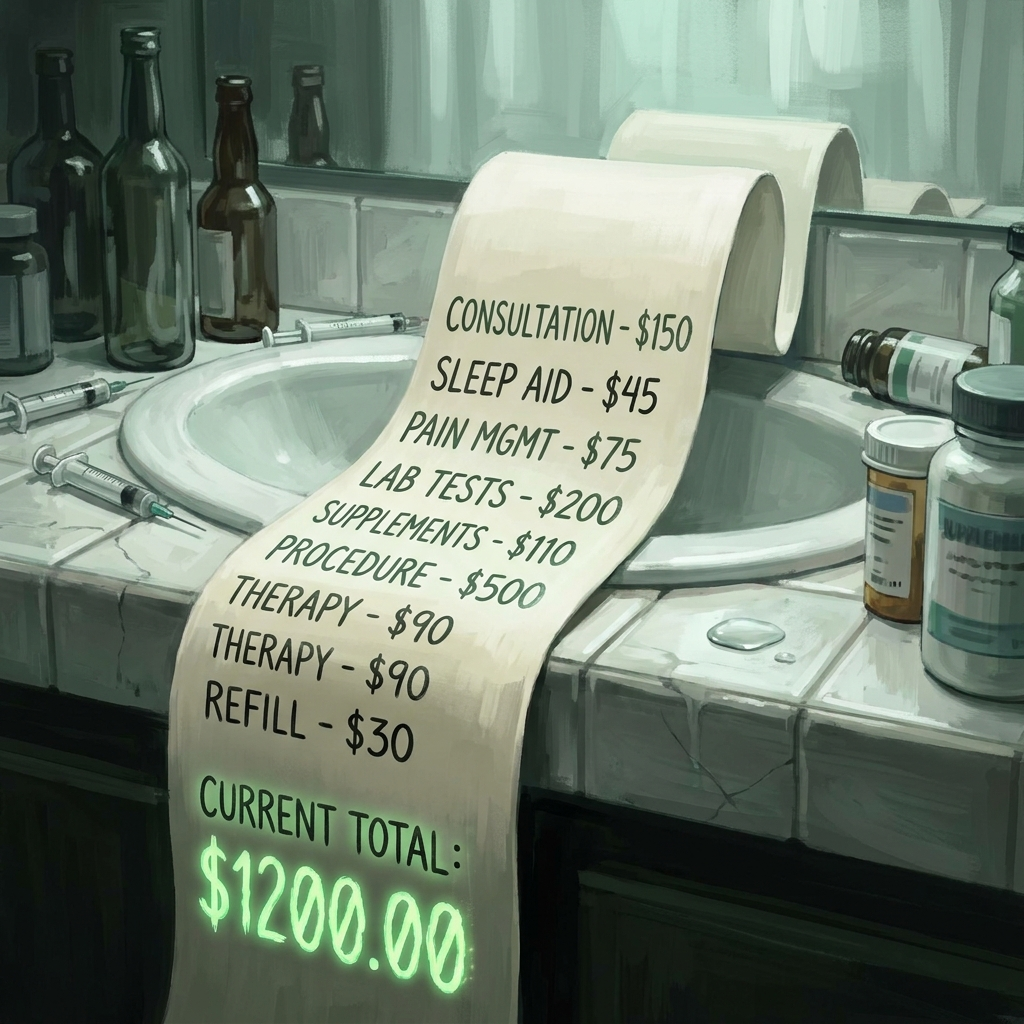
Let me show you exactly why every product I'd been selling failed Jennifer. And what they're really costing you.
And you're still losing hair.
Because nobody's addressing the actual cause.
Iras' generation didn't spend a dime on any of this. She didn't need to. The four ingredients she used cost the equivalent of a few hours of a household servant's wages.
Two thousand years later, women are spending fifty thousand dollars to fail at the same problem Iras solved in a clay pot.
That's not progress. That's robbery.
The Ancient Ingredients, Now Confirmed By Modern Science
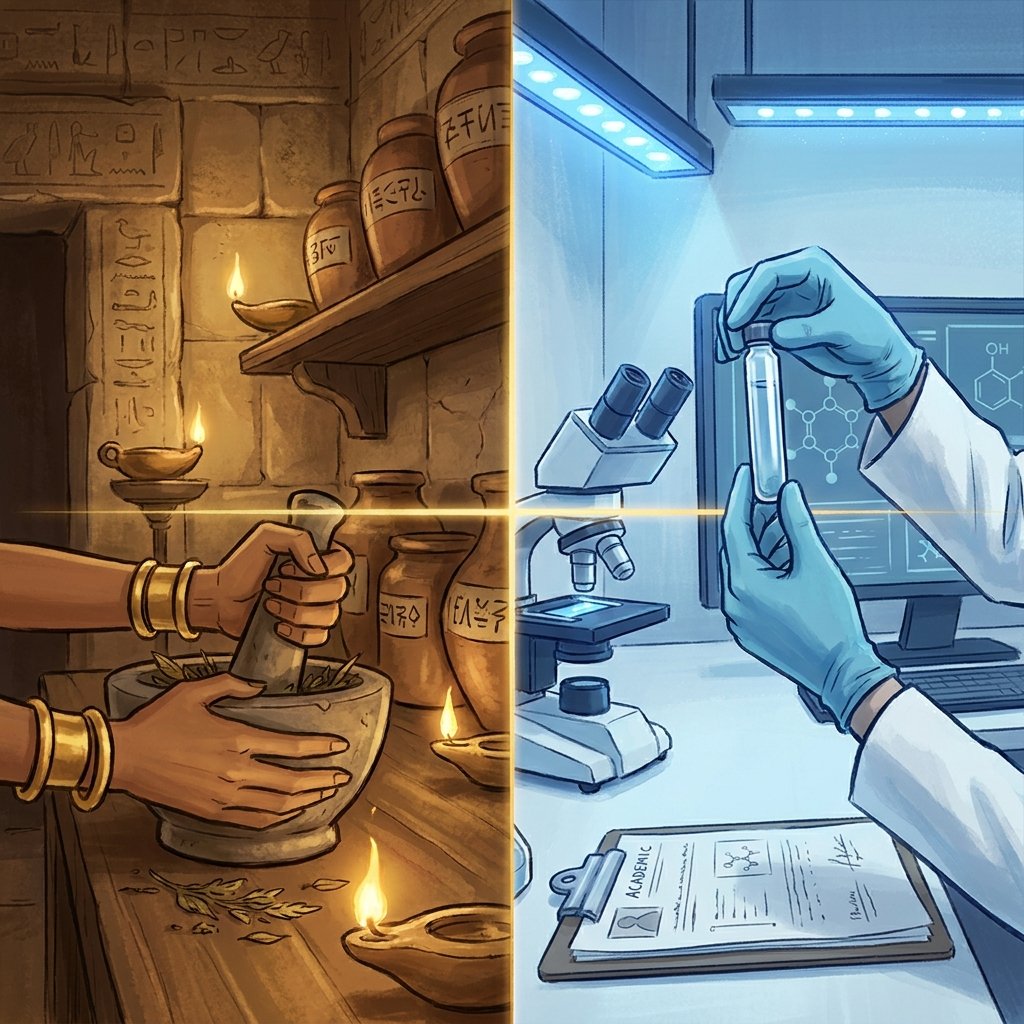
When Lisa brought me her four ingredients, I pulled every clinical study I could find. What I'm about to show you is what convinced me — a board-certified dermatologist with 15 years of conventional practice — that the answer had been hiding in plain sight for 2,000 years.
Iras knew it as the bitter yellow flower. Used in Egyptian and Chinese medicine for hair preservation since at least 200 BC.
Modern clinical research published in the Journal of Dermatological Science showed it inhibits 5α-reductase — the enzyme that creates DHT — by up to 67%.
Read that again. 67% reduction in the enzyme that's causing your hair loss. From a plant Cleopatra's hairdresser was using before the Roman Empire existed.
Not your morning coffee. Iras used it in concentrated topical preparations applied directly to the scalp.
Published research in the International Journal of Dermatology confirmed that topical caffeine at 0.2% concentration blocks DHT from binding to follicle receptors and extends the anagen (growth) phase. One study found it non-inferior to 5% minoxidil — without minoxidil's side effects, irritation, or dependency cycle.
Standardized for 5α-reductase inhibition. Rich in gamma-oryzanol and ferulic acid.
A study from Seoul National University showed it increased follicle density by 34% in 12 weeks.
The Yao women of Huangluo, China — famous for floor-length jet-black hair into their 80s — have been fermenting and applying rice water topically for centuries. Iras' formulations included a similar preparation. They didn't know the chemistry. They just knew it worked.
Full-spectrum extract for follicle defense and microcirculation. The same traditional preparation used in Traditional Chinese Medicine for over 2,000 years.
Modern research confirms it protects follicles from DHT damage and improves blood flow to the scalp — addressing both the hormonal attack and the nutrient delivery problem.
These weren't homeopathic trace amounts. These were clinically effective doses — the same doses used in the published studies, the same potency Iras would have used in her formulations.
But here was the critical insight Lisa and I kept coming back to:
These ingredients had to be applied directly to the scalp. Not swallowed in a pill where stomach acid destroys 95% of them. Not diluted in a shampoo that rinses off in 60 seconds. Not buried in a 95% water "thickening serum" where the concentration is too low to do anything.
Directly to the scalp. Where the DHT damage is actually happening.
Iras knew this 2,000 years ago.
Modern beauty companies are still pretending they don't.
The 60-Second Forgotten Ritual We Reconstructed Together
That's where I came in.
Dr. Holmes had the science. She had the clinical doses. She had 47 peer-reviewed studies on her desk confirming that what Iras had figured out in 30 BC was exactly what modern dermatology should have been doing all along.
But I knew what women would actually use.
I'd watched 22 years of clients abandon messy oils, greasy serums, and complicated multi-step routines. I'd watched women buy "miracle" products and stop using them after a week because they made their hair feel weird, smelled like a science experiment, or required them to wash their hair before styling — every single morning.
Whatever Dr. Holmes and I created, it had to fit into a real woman's actual life.
Iras' formulations were elegant for a reason. She knew Cleopatra wasn't going to spend 30 minutes a day on a hair routine in the Egyptian heat. The original preparations were quick. Topical. Daily. Designed to disappear into the queen's skin and scalp without leaving residue or scent.
We rebuilt that.
Not as a paste. Not as an oil. As a fine, light spray.
Sixty seconds. Spray on your scalp. Along your part. At your crown. Around your hairline. Done.
No greasy residue. No chemical smell that announces "I'm treating my hair loss" to everyone in the room. No additional steps before you style. No prescription. No dependency.
Just the four ingredients Iras used — at the exact clinical doses Dr. Holmes' research confirmed — delivered exactly where DHT is doing its damage.
A 2,000-year-old recipe. A 60-second modern ritual.
We tested 14 different formulations. We rejected 13 of them. The one that worked is the one you'll see in a few sections from now.
But before we start telling you what other women experienced — let me tell you what happened when Dr. Holmes and I tested it on the only test subjects we trusted completely.
Ourselves.
The First Test Subjects: Us

Here's something I never told my clients.
I was hiding my own hair loss from them.
For three years.
Talk about irony — the cosmetologist whose own hair was falling out, recommending products to other women that I knew weren't working on me either.
At 44, my widening part had gotten so visible under salon lights that I'd started parting my hair on the opposite side just to hide it. I was doing the same thing to myself that I'd been doing to Jennifer for six years. Decorating the loss.
Dr. Holmes admitted something similar on our second call.
At 47, her own hair was thinning. Crown showing through under overhead lights. Hair everywhere — her pillow, her shower drain, even on her car seat. She was a board-certified dermatologist who specialized in hair and scalp conditions. And she was hiding her own hair loss from her patients.
We were both living proof that the "standard of care" wasn't working.
So we became our own guinea pigs.
Every morning and night, we sprayed the formula on our scalps. Along our parts. At our crowns. Around our hairlines.
It took 60 seconds.
No burning. No grease. No weird chemical smell. It actually smelled fantastic — because it was using ingredients only found in nature.
Here's what happened next:
Week 1: I counted the hairs in my shower drain. Went from 80–100 hairs to about 35. I thought I was imagining it. Counted again the next day. Still 35.
Week 2: Less hair wrapping around my brush between clients. I used to clean my brush three times a day. Now once.
Week 3: Tiny baby hairs along my part line. Little wisps standing straight up. I took photos because I couldn't believe it.
Week 4: Baby hairs along my temples. Little wisps I could see when I pulled my hair back for work. They hadn't been there in years.
Week 6: My own hairdresser asked what I was doing differently. "Your hair feels thicker," she said. "And you have all this new growth at your hairline."
Week 8: A longtime client looked at me mid-appointment and said, "Lisa, did you get extensions? Your hair looks incredible." I almost cried.
Week 10: I wore my hair down at work for the first time in two years. No scarf. No strategic updo. Just… my hair. And I didn't think about it once.
Week 12: I had the hair thickness I remembered from my thirties. Not teenage hair. Just… normal. Healthy. Mine.
I'd spent 22 years behind the chair. I'd never seen anything work this fast. Not on my clients, and definitely not on me.
Dr. Holmes' results tracked almost identically with mine.
That's when we knew this was bigger than two women's vanity projects.
This was the answer 40 million American women had been waiting for.
The Patient Revolution
We started with my most desperate clients. The ones I was about to lose. The women who were one bad appointment away from buying a wig and never coming back.
Women who'd spent thousands and given up hope.
Women who were considering wigs.
Women who'd been told "just accept it, it's aging."
Jennifer was first.
Remember her? The kindergarten teacher who broke down in my salon chair?
I gave her a bottle. Told her to use it every morning and night for 60 seconds. That's all.
Six weeks later, she walked back into my salon.
She was wearing her hair down. Actually DOWN. First time in two years.
She sat in my chair, looked at her reflection, and said:
She was crying. But this time, happy tears.
Then word spread. Not just through Dr. Holmes' practice — through my salon. Clients told their friends. Those friends called asking if they could "get some of that spray Lisa uses."
Patricia, 58 years old. Had spent $8,000 on failed treatments over three years. Minoxidil, PRP injections, laser cap therapy. After 6 weeks: "I'm seeing thickness I haven't had since my early 40s. My husband keeps complimenting my hair. This $40 spray did more than $8,000 worth of treatments."
Margaret, 61. Was taking four Nutrafol pills a day at $88/month. After 8 weeks: "Four pills a day. For a year. Did absolutely nothing. This spray gave me visible results in one month. I cancelled my supplement subscription. Best decision I ever made."
Sarah, 55. Burned through $12,000 on two hair transplant procedures that "didn't take." After 10 weeks: "I can see baby hairs filling in where the transplants failed. For 1/100th the cost and none of the pain."
Within six months, we had a waiting list of 300 women desperate to try what we were calling our "DHT Defense Spray."
That's when we knew this was bigger than one practice or one salon.
That's also when the industry came for us.
Cease-And-Desist Letters Started Arriving. Then The Supply Chain Got Sabotaged. We Knew We Were Onto Something.

I knew what would happen if we went public. But I didn't expect it so fast. Or so aggressively.
First came the "friendly" warnings.
A hair transplant surgeon I'd known for years pulled me aside at a dermatology conference:
"Yolanda, what you're doing is dangerous. These women need REAL medical treatment. You're giving them false hope. You should stop before you lose your license."
Translation: "You're cutting into our revenue and we don't like it."
Then came the legal threats.
Three cease and desist letters.All from the same law firm. All representing "concerned dermatologists and medical professionals."
Claiming I was making "unsubstantiated medical claims" and "practicing outside the standard of care."
Even though I had 47 peer-reviewed studies backing every single ingredient in our formula.
Even though the "standard of care" keeps women trapped in $15,000 treatment cycles.
They wanted me silent.
Then came the supply chain sabotage.
Lisa's botanical supplier — a company we'd worked with for eight months — suddenly "couldn't fulfill our orders."
"Corporate decision, nothing personal, Dr. Holmes."
Two weeks later, we found out they'd been acquired by a major beauty conglomerate.
Why are they so desperate to stop us?
Because we'd created something that could make their entire business model obsolete. A spray that:
✓ Fixes the ROOT CAUSE of hormonal hair loss (not just symptoms)
✓ Works in 60 seconds a day (not twice-weekly appointments)
✓ Costs less than ONE MONTH of minoxidil (not thousands in procedures)
✓ Lets women fix themselves at home (not in $5 million medical spas)
Every woman who uses our spray and gets her hair back is a customer they lose.
Forever.
That's why they're fighting so hard.
On Lisa's end, the pushback was different but just as real.
Her salon distributor — the one who'd supplied her products for 15 years — told her she was "hurting the professional hair care industry" by recommending a direct-to-consumer spray over their $80 salon treatments.
Two product reps stopped returning her calls. Another stylist in her building told clients Lisa had "gone off the deep end and was recommending some internet product."
All because we were telling women the truth: the products on the shelf weren't fixing the problem. They never had been.
The Spray Iras Would Have Made If She Had Modern Equipment
We partnered with a small, family-owned laboratory in the United States.
They agreed to produce our exact formula with zero compromises.
No dilution. No cheap substitutes. No proprietary "black box" blends where you don't know what you're getting.
Complete transparency. Clinical doses. Real results.
We called it TryBello Hair Helper Spray.
This is the spray Iras would have made if she'd had modern lab equipment. The same four ingredients she used in 30 BC. The same delivery principle (direct topical application). The same daily ritual structure. Just engineered for the modern woman's life and reformulated to clinical-grade modern standards.
It's the ONLY topical spray on earth that delivers all three requirements for lasting hair restoration:
The Triple-Defense System
Sophora Flavescens Extract and Rice Extract work at the enzyme level. They inhibit 5α-reductase — the enzyme that converts testosterone into DHT.
Less enzyme activity = less DHT being produced = less DHT strangling your follicles.
Caffeine and Angelica Root create a protective barrier. Even if DHT is circulating in your system, it can't BIND to your follicle receptors.
Your existing hair is protected from miniaturization.
With DHT blocked and existing follicles protected, something amazing happens: follicles that have been "sleeping" — dormant but not dead — can return to their normal growth cycle.
Blood flow increases. Nutrient delivery resumes. The follicle "wakes up." And it starts producing thicker, stronger, longer hair again.
This is why TryBello works when everything else fails.
Every ingredient is at clinical-grade concentration. Every ingredient is tied to peer-reviewed research. Every ingredient is something Iras' generation knew about and Big Beauty has been pretending doesn't exist.
Real Women, Real Transformations
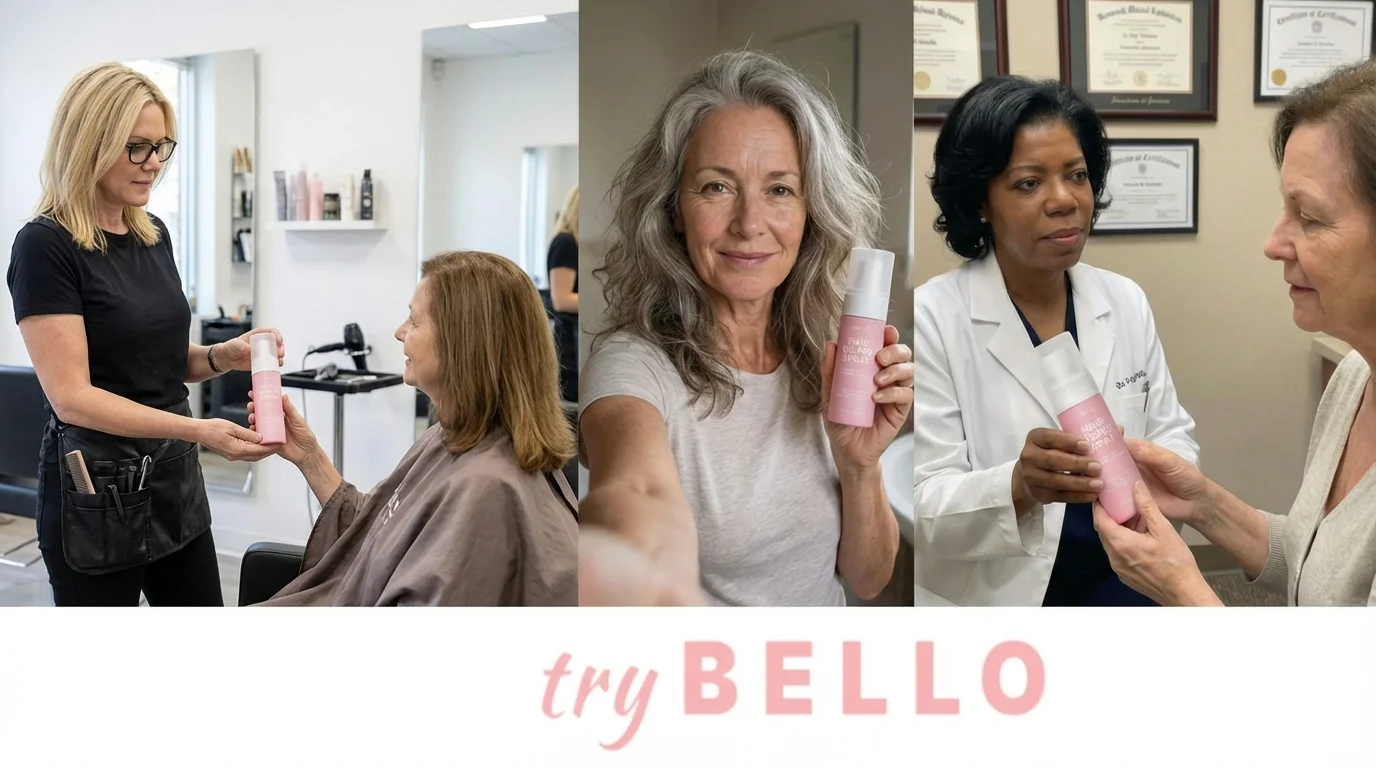
In the last two years, over 88,000 women have used the spray Iras inspired and reversed their hair thinning.
Here are their stories:
Compare That To The "Gold Standard" Treatments:
- Rogaine/Minoxidil: 38% see improvement (with side effects like unwanted facial hair and scalp irritation)
- Popular supplements (Viviscal, Nutrafol): 22% see mild improvement after 6 months of daily pills
- Biotin alone: 11% see any change (and only if they were deficient to begin with)
The difference isn't subtle. It's massive.
They're Trying To Bury Us In Legal Fees. Here's Our Response: 65% Off, While We Still Can.

Remember those cease and desist letters we mentioned?
The threats? The supplier blacklisting?
Well, we just got word that a major beauty conglomerate is trying to patent-block our botanical extraction process.
They can't copy it — we have iron-clad patents.
They can't buy us — we told them no.
So now they're trying to bury us in legal fees. Drag us through years of patent litigation until we run out of money.
Here's our response:
We're putting 10,000 units on sale at 65% OFF.
That's right.
Just $25 per bottle.
Less than ONE chiropractor appointment. Less than your monthly Rogaine refill. Less than that "miracle" shampoo that did nothing.
For the ONLY spray that actually fixes the root cause of hormonal hair loss.
Regular price: $80 per bottle (Already 75% less than one month of typical treatment)
When you opt for the 4 Months Supply your price today: $25 per bottle
Why would we do this?
Because every woman who gets her hair back is a middle finger to the corrupt system that kept her sick.
Because we want 10,000 success stories posted online before these medical vultures can silence us.
Because Jennifer's husband just bought her flowers for the first time in two years — and we want that for 10,000 more women.
BUT — this 65% discount dies in 48 hours.
Not playing games. Our legal bills are very real and very expensive.
After 48 hours: Price goes back to $80.
Still worth it. But not $25.
Also: We only have 4,200 units left at this price.
Our lab in the Pacific Northwest can only produce 800 bottles per week.
When Good Morning America featured us last month, we sold out in 11 hours. Completely gone.
Took us three weeks to restock.
If you're reading this, units are available NOW. But I can't promise they'll last the day.
Every minute you wait is another minute you're feeding the pill companies, enriching the surgeons, and missing out on the solution that's sitting right here for less than a dinner out.
Our Personal 120-Day Guarantee

Look, we get it.
You've been burned before.
Spent money on "miracle cures" that now collect dust under your bathroom sink. Supplements that promised results in "just 90 days" and did nothing. Devices that looked great in the infomercial and broke after two uses.
We're not asking you to trust us.
We're asking you to TEST us.
Here's our promise:
Use Hair Helper Spray for 120 days.
Spray it on your scalp every morning and night. Sixty seconds. That's all.
Count the hairs in your shower drain. (They'll decrease.)
Take weekly photos of your part. (It'll tighten.)
Feel for baby hairs along your hairline. (They'll appear.)
Track how often you're touching your hair nervously. (You'll stop.)
And if you don't wake up one morning thinking:
"Wait… I forgot to obsess about my hair today."
"My part doesn't show through under these lights anymore."
"I can actually wear my hair in a ponytail again."
"My hairdresser asked what I'm doing differently."
We'll refund every single penny.
No forms to fill out. No "store credit" nonsense. No 20-minute phone call with a "retention specialist." Just email support@trybello.com and say "it didn't work."
We'll send you a prepaid return label.
Your refund hits your account within 48 hours.
Why are we so confident?
Because in two years and 88,000 customers, our refund rate is 2.8%.
That's 97.2% of women who got results and never looked back.
And half of those 2.8% returns? Wrong address deliveries or husbands who accidentally threw out the bottle thinking it was empty.
The actual "didn't work" rate is barely 1%.
When you address the root cause, results aren't a mystery.
They're inevitable.
The Two Paths

Right now, you're standing at a crossroads.
Two paths stretch out in front of you.
Only one leads to thicker hair.
- Keep counting hairs in your brush every morning
- Keep avoiding mirrors in bright lighting
- Keep wearing your hair in that same pulled-back style
- Keep spending $200–500/month on solutions that create dependency, not results
- Keep being a recurring revenue stream for companies that NEED you to stay desperate
- Keep skipping family photos because you "don't look like yourself"
- Keep watching your husband's hand pass over your head without running through your hair
- Keep waking up with that sinking feeling when you see more hair on your pillow
- Keep pretending you're "fine with aging naturally" while dying inside every time you catch your reflection
- Keep giving your money to an industry that profits from your pain
- Spend less than you'd blow on a dinner out
- Get a spray that's helped 91% of users see results within 2 weeks
- Fix the ROOT CAUSE instead of masking symptoms
- Wake up in 14 days with noticeably less hair in your drain
- Wake up in 30 days with baby hairs you can feel along your temples
- Wake up in 60 days with your hairdresser asking what you're doing differently
- Wake up in 90 days with your confidence back
- Take a photo with your family without strategically positioning yourself
- Feel your husband run his fingers through your hair again
- Stop obsessing over your hair and start living your life
The choice is yours.
But only one path gives you a 120-day money-back guarantee.
Only one path costs less than ONE month of the treatments that aren't working.
Only one path addresses the hormone that modern life supercharged — the one that's strangling your follicles right now.
What To Do Next
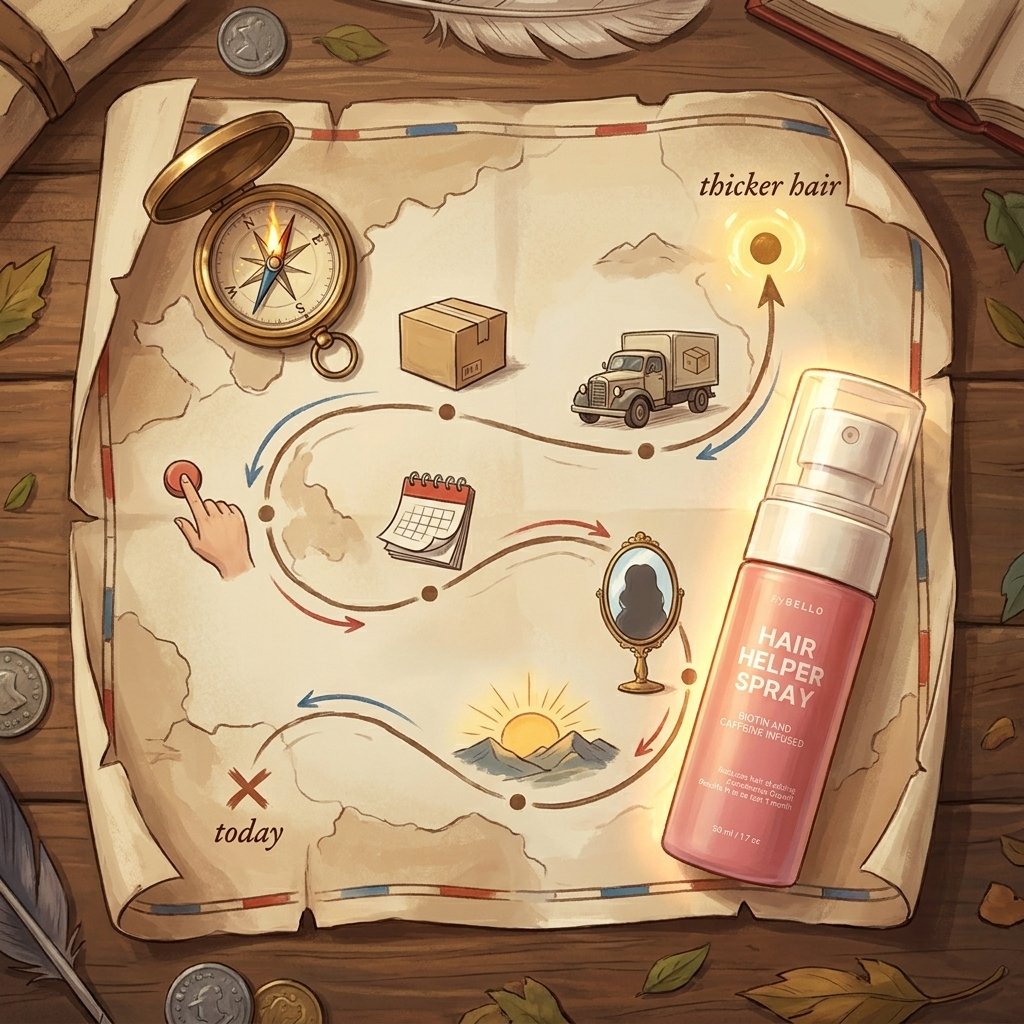
Here's exactly what to do right now:
1. Click the "CLAIM MY 65% DISCOUNT" button below.
2. Choose your package. Pro tip: Most women see best results at 16 weeks. That's 4 bottles. That's why our most popular package is The 4 Months Supply (4 bottles) — because it gives you 16 weeks of treatment.
3. Fill out your shipping info. We ship same-day if you order before 3 PM EST. Next day if after.
4. Wait 3–5 days for your package to arrive.
5. Use it for 60 seconds 2x daily when it arrives. Spray along your part. At your crown. Around your hairline. Massage gently for 30 seconds.
6. Start your countdown to thicker hair:
Week 1: Less shedding
Week 2: Even less shedding
Week 4: Baby hairs appearing
Week 8: Visible thickness
Week 12: Hair you recognize as YOURS
But whatever you do, don't close this page thinking "I'll order later."
Later doesn't exist when 4,200 units are all that's left.
Later = the discount expires (48 hours from RIGHT NOW)
Later = units sell out (happened in 11 hours last time)
Later = another month of avoiding overhead lighting
Later = another $150 spent on Rogaine that won't fix anything
Later = another family gathering where you strategically hide in photos
Your follicles have been suffocating under DHT long enough.
They're not dead. They're waiting.
Waiting for someone to block the hormone that modern life unleashed on them.
Waiting for someone to undo what your grandmother's generation never had to face.
Waiting for you to give them one more chance.
Click below. Let's end this nightmare.
NOTE: This deal is NOT available on Amazon or eBay. Beware of knockoff products. TryBello is only sold through our official website.
Iras Couldn't Save Cleopatra From What Came At The End. But She Could Keep Her Hair Thick Until The Day She Died. That's What We're Offering You.
Two thousand years ago, a woman named Iras stood beside the most powerful queen in the ancient world.
She couldn't save Cleopatra from what came at the end. She couldn't stop the asps. She couldn't change the Battle of Actium. She couldn't rewrite the politics of Rome.
But she could keep her queen's hair thick until the day she died.
For 11 years, Iras did exactly that. With four ingredients. Daily. Topically. With nothing but a clay pot and the inherited knowledge of generations of Egyptian cosmeticians before her.
When Cleopatra died, Iras chose to die beside her — and Roman historians wrote down what she'd known.
That knowledge has been buried for 2,000 years.
Until now.
Two women who refuse to stay silent.
P.S.I just got a text from Jennifer — the kindergarten teacher who broke down in my salon chair at the opening of this article. She's at her daughter's wedding rehearsal right now. Wearing her hair DOWN. Smiling in the photos for the first time in two years. That could be you in 12 weeks. But only if you act now.
P.P.S.Hair Helper is clinically tested and recommended by board-certified dermatologists AND trusted by working stylists who see the results in their chairs every single day. The ones who aren't on Big Beauty's payroll, anyway.
P.P.P.S.Seriously, we're down to 4,200 units. When I refresh our inventory system and see it below 1,000, I'm pulling this page and this discount. Don't say I didn't warn you.